 11
11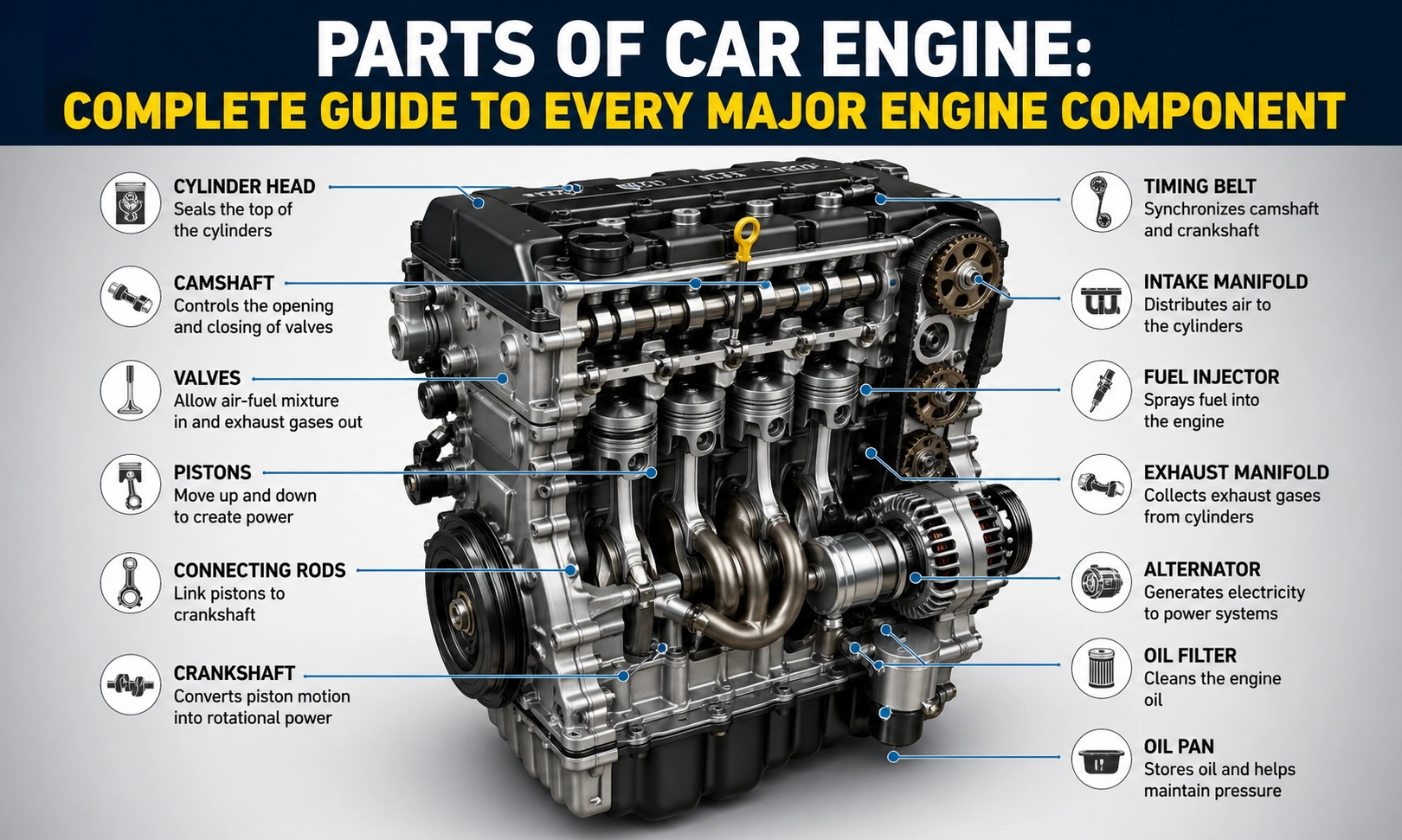
A car engine is like the heart of your vehicle. It creates power and keeps everything moving. Without it, your car would simply sit still. That is why learning about the parts of car engine is so important.
Many drivers know how to steer, brake, and fill gas. But few understand what happens under the hood. Knowing the basic engine parts can help you spot problems early. It can also save you money on repairs.
Think of an engine as a team. Every part has a special job. When all the parts work together, your car runs smoothly. If one part fails, the whole system can suffer.
In this guide, we will explore all the major parts of car engine. You will learn what each part does, why it matters, and how it helps your car perform better. Whether you are a beginner or just curious, this guide makes engine parts easy to understand.
A car engine is a machine that turns fuel into motion. It burns fuel inside small chambers. This creates energy. That energy moves pistons, which turn the wheels.
Modern cars mostly use internal combustion engines. These engines combine air and fuel. A spark ignites the mixture. The small explosion creates power.
There are many moving parts inside an engine. Each one plays an important role. Some parts move. Others control heat, airflow, or timing.
Learning the parts of a car engine can make car ownership less confusing. It helps you understand repairs and maintenance. You will also feel more confident when speaking to a mechanic.
Before diving deeper, here is a quick look at the essential engine components.
| Engine Part | Main Function |
|---|---|
| Engine Block | Houses major components |
| Pistons | Create motion from combustion |
| Crankshaft | Converts up-and-down motion into rotation |
| Camshaft | Controls valve movement |
| Cylinder Head | Seals the cylinders |
| Valves | Regulate airflow |
| Spark Plugs | Ignite fuel |
| Timing Belt | Synchronizes engine movement |
This simple parts of car engine list covers the most important components found in most gasoline vehicles.
The engine block is the largest part. It serves as the main body of the engine. Almost every other component attaches to it.
It contains the cylinders where combustion happens. It also holds coolant passages and oil channels. These help control temperature and lubrication.
Most engine blocks are made from aluminum or cast iron. Aluminum is lighter. Cast iron is stronger.
Without the engine block, there would be no place for the other components to work. It truly is the backbone of the engine.
Cylinders are round chambers inside the engine block. This is where fuel burns.
Each cylinder contains a piston. When fuel ignites, the piston moves downward. This creates power.
Cars can have different numbers of cylinders. Common options include:
More cylinders often mean more power. However, they can also use more fuel.
Understanding the cylinders is key when learning the parts of the engine in a car.
Pistons move up and down inside the cylinders. They are among the hardest-working engine parts.
When fuel explodes, the piston gets pushed down. It then moves back up to repeat the cycle.
Pistons must handle extreme heat and pressure. They are usually made from lightweight aluminum.
A damaged piston can cause serious engine trouble. That is why proper maintenance is so important.
Connecting rods link the pistons to the crankshaft. They transfer motion from one part to another.
The crankshaft changes the piston’s up-and-down movement into spinning motion. This spinning power eventually turns the wheels.
Together, these parts form the engine’s rotating assembly. They are critical for smooth operation.
If the crankshaft fails, the engine usually stops completely.
The cylinder head sits on top of the engine block. It seals the cylinders and contains many important components.
It houses:
A head gasket sits between the cylinder head and engine block. It prevents leaks.
A blown head gasket can cause overheating, oil mixing, and expensive repairs.
Valves open and close at precise moments. They control airflow into and out of the cylinders.
There are two main types:
Intake valves let air and fuel enter. Exhaust valves release burned gases.
Proper valve timing is essential. Even a small timing issue can hurt performance.
The camshaft controls the opening and closing of the valves.
It has special lobes that push the valves open. Springs close them again.
Some engines have one camshaft. Others have two or more.
A faulty camshaft can cause rough idling, poor acceleration, and engine noise.
Spark plugs ignite the air-fuel mixture.
They create a tiny electric spark inside each cylinder. That spark starts combustion.
Without spark plugs, gasoline engines cannot run.
Bad spark plugs often cause:
Replacing them regularly keeps your engine healthy.
Fuel injectors spray fuel into the engine.
Modern injectors are highly precise. They deliver the exact amount needed.
This improves:
Dirty injectors can reduce power and waste fuel.
Keeping them clean helps maintain engine performance.
The timing belt keeps the crankshaft and camshaft synchronized.
This ensures valves open at the right moment.
Some engines use a timing chain instead. Chains usually last longer.
A broken timing belt can cause major engine damage.
Always replace it according to your manufacturer’s schedule.
| Timing Component | Lifespan |
|---|---|
| Timing Belt | 60,000–100,000 miles |
| Timing Chain | Often lifetime of engine |
The oil pan stores engine oil at the bottom of the engine.
Oil lubricates moving parts. It reduces friction and prevents wear.
The oil pump circulates oil throughout the engine.
Clean oil is vital for engine life.
Skipping oil changes can ruin an engine quickly.
Engines produce a lot of heat. The cooling system prevents overheating.
Key components include:
These parts work together to maintain the right temperature.
Overheating can cause severe damage in minutes.
The intake manifold distributes air evenly to each cylinder.
The exhaust manifold collects exhaust gases and sends them away.
Both parts improve efficiency and performance.
Leaks in either manifold can cause problems like poor fuel economy or loud noises.
A basic diagram of car engine parts usually includes:
This visual layout helps beginners understand how everything connects.
| Category | Components |
|---|---|
| Internal Parts | Pistons, Rings, Rods, Crankshaft |
| Valve Train | Camshaft, Valves, Lifters |
| Ignition | Spark Plugs, Coils |
| Fuel System | Injectors, Fuel Rail |
| Lubrication | Oil Pump, Oil Pan |
| Cooling | Water Pump, Thermostat |
This list of engine parts in a car covers the core systems.
Knowing symptoms can help prevent major repairs.
Watch for:
Early diagnosis can save thousands of dollars.
Good maintenance keeps engine parts healthy.
Important steps include:
A well-maintained engine can last over 200,000 miles.
Knowing the parts name of car engine gives you confidence.
You can:
It also makes car ownership much less stressful.
The main parts include the engine block, pistons, crankshaft, camshaft, cylinder head, valves, and spark plugs.
A modern engine contains hundreds of components, but around 20 major parts handle most functions.
The engine block is often considered the most important because it houses the primary components.
A professional inspection during every major service is recommended.
Poor maintenance, overheating, lack of oil, and normal wear are common causes.
Yes, many simple tasks like changing spark plugs or filters are beginner-friendly.
Understanding the parts of car engine is one of the best things any car owner can do. It helps you maintain your vehicle, avoid costly repairs, and drive with confidence.
Every component has a purpose. From pistons to spark plugs, each part works together like a team. When one part struggles, the entire engine can suffer.
You do not need to be a mechanic to understand the basics. A little knowledge goes a long way.