 11
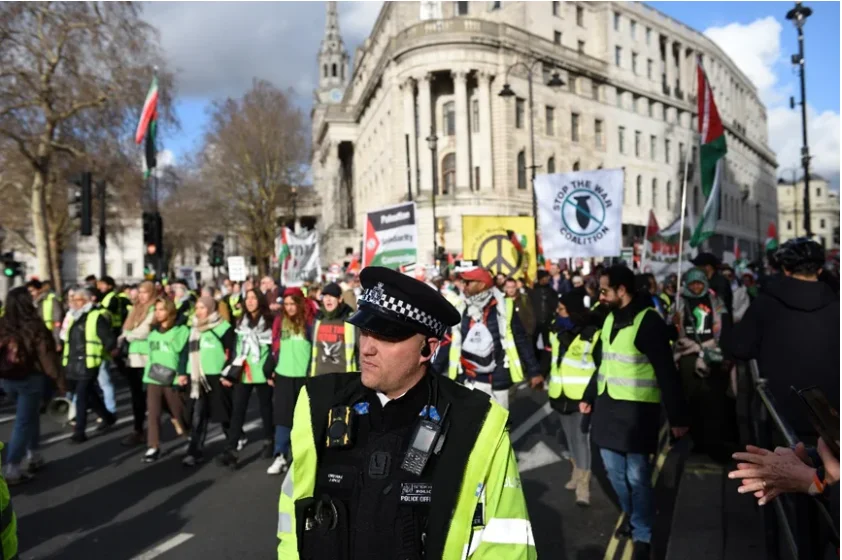
11 Thousands of demonstrators gathered in central London on 16 May 2026 for Nakba 78: March for Palestine, a large pro-Palestinian march linked to the ongoing Gaza conflict, prompting renewed debate over protest and public safety.
The march, organised by pro-Palestinian coalition (Stand Up To Racism, Palestine Solidarity Campaign, Stop the War Coalition, Friends of Al-Aqsa, Palestinian Forum in Britain, Muslim Association of Britain and CND), commemorated the displacement of Palestinians during the creation of Israel in 1948 and drew significant crowds into central areas of the capital. Organisers said the demonstration would focus on humanitarian concerns, demands for a ceasefire and solidarity with civilians affected by the war in Gaza. Police estimates put the Nakba 78: March for Palestine at around 30,000 participants, while organisers claimed the crowd exceeded 250,000, and the combined total of the pro-Palestinian and far-right demonstrations on 16 May was tens of thousands, with earlier estimates suggesting at least 80,000 people in total.
Yet, as with several large protests held in London over recent months, the event became entangled in broader political arguments around extremism, migration, policing and social cohesion in modern Britain.
For many Londoners, tourists and commuters, concerns were less ideological and more practical. Did the demonstrations remain peaceful? Did violence break out between rival groups? And ultimately, was London safe during politically charged weekends such as this one?
London has long functioned as one of the world’s principal centres for public protest. Demonstrations linked to wars, economic crises, climate activism and political movements regularly attract tens of thousands of participants to Westminster and surrounding districts.
Most protests pass without major incident. However, the scale and emotional intensity of demonstrations surrounding the Israel-Gaza conflict have heightened public anxiety. Pro-Palestinian marches have become some of the largest political gatherings seen in Britain in recent years, while counterprotests and online rhetoric have sharpened tensions further.
Police have repeatedly stressed that the overwhelming majority of demonstrators act lawfully. Nonetheless, isolated incidents involving arrests, public order offences and allegations of hate speech have received extensive media attention.
As a result, public perception of safety in London increasingly fluctuates according to the political climate. Viral footage of confrontations, aggressive chanting or heavy police deployments can create the impression of widespread instability even when incidents remain geographically limited.
The question of whether London is safe therefore reflects not only concerns about crime or terrorism, but also growing unease about political polarisation and social unrest.
The Metropolitan Police deployed substantial resources during the Nakba Day march, including public order officers and crowd-control measures aimed at preventing clashes between opposing groups.
Counterdemonstrations were anticipated from pro-Israel activists and nationalist organisations, including a far-right rally led by Tommy Robinson on the same day. This increased the risk of confrontation in already crowded parts of central London. Previous protests linked to the Gaza conflict had occasionally seen tensions escalate between rival demonstrators, although large-scale violence remained relatively rare.
Police commanders faced an increasingly difficult balancing act. Britain’s protest laws protect freedom of assembly and political expression, yet authorities are also under pressure to prevent intimidation, disruption and disorder.
Criticism came from multiple directions. Pro-Palestinian activists argued police had imposed excessive restrictions on demonstrations and unfairly associated protest movements with extremism. Opponents of the marches, meanwhile, claimed police had failed to respond robustly enough to inflammatory slogans or incidents of antisemitism.
The wider political atmosphere has become increasingly charged. Public trust in institutions, policing and political leadership remains fragile after years of Brexit divisions, economic pressure and debates over immigration and national identity.
The Nakba Day march also touched on one of Britain’s most divisive political issues: migration and multiculturalism.
From a right-wing British perspective, the scale of pro-Palestinian mobilisation in London is often presented as evidence of deeper cultural fragmentation linked to decades of high migration. Critics argue rapid demographic change has weakened social cohesion and created parallel political identities in major cities.
Some commentators claim repeated demonstrations centred around overseas conflicts leave parts of the public feeling alienated within their own capital. They argue governments have failed to address legitimate concerns surrounding integration, shared national identity and pressure on housing, schools and public services resulting from sustained high immigration levels.
Supporters of multiculturalism strongly dispute that interpretation. They point out Britain has long been shaped by migration and argue the right to protest international humanitarian issues is consistent with democratic participation rather than evidence of social breakdown.
Many participants in Nakba Day demonstrations included students, trade unionists, faith organisations and activists from diverse backgrounds, not solely Britain’s Muslim communities.
Nevertheless, migration has become increasingly central to political discourse in Britain, and large demonstrations often become symbolic flashpoints within wider culture-war debates.
Despite heightened political tensions, London remains one of the world’s leading global cities and continues to attract millions of tourists annually. Most visitors experience the capital without encountering any direct disruption linked to protests.
However, demonstrations of this scale can create practical complications. Road closures, transport disruption and visible police operations were concentrated around Westminster, Whitehall and other central areas during the Nakba Day march.
Security experts generally advised visitors to avoid protest routes where possible, particularly when counterdemonstrations were expected. The main risks tended to involve overcrowding, travel delays or isolated confrontations rather than widespread danger across the city.
For those asking whether London is safe during major protests, the answer is nuanced. In broad terms, yes — the capital remains heavily policed, internationally connected and operationally resilient. Yet periods of heightened political tension can create localised risks, particularly where rival groups gather in close proximity.
London’s reputation for safety is also shaped by wider concerns over crime, anti-social behaviour and terrorism. Like many major global cities, it faces ongoing challenges linked to knife crime, policing pressures and public confidence. Political demonstrations add another visible layer to those anxieties, especially when amplified through social media.
The Gaza war has had profound consequences far beyond the Middle East, influencing political debate throughout Europe and North America. In Britain, the conflict has become deeply intertwined with questions of free speech, multiculturalism, antisemitism and national identity.
Universities, councils, broadcasters and political parties have all faced internal disputes linked to the conflict. Public figures on both the left and right have accused opponents of either tolerating extremism or suppressing legitimate dissent.
The Nakba Day march reflects how international crises increasingly shape domestic politics in an era of digital activism and global migration. Demonstrations in London are no longer viewed simply as foreign policy protests, but as symbols within broader arguments over what modern Britain represents.
For some, the marches embody democratic engagement and humanitarian solidarity. For others, they symbolise a country becoming more politically fragmented and culturally uncertain.
How authorities managed the 16 May demonstrations is likely to influence public perceptions far beyond a single weekend. Peaceful protests with minimal disruption could reinforce confidence in London’s ability to accommodate large-scale political expression safely.
Any serious disorder, however, would likely intensify already heated debates surrounding migration, protest laws and policing standards.
The challenge for Britain’s institutions is increasingly complex: preserving democratic freedoms while maintaining public order in a society that feels more politically polarised than at any point in recent decades.
The question “is London safe?” ultimately reveals something deeper than concerns over one demonstration. It reflects broader uncertainty about the direction of British society itself — its identity, cohesion and capacity to manage disagreement peacefully in a period of rapid social and political change.
As crowds gathered again in central London, the city once more found itself balancing openness with security, protest with stability, and democratic expression with growing public anxiety over division and disorder.